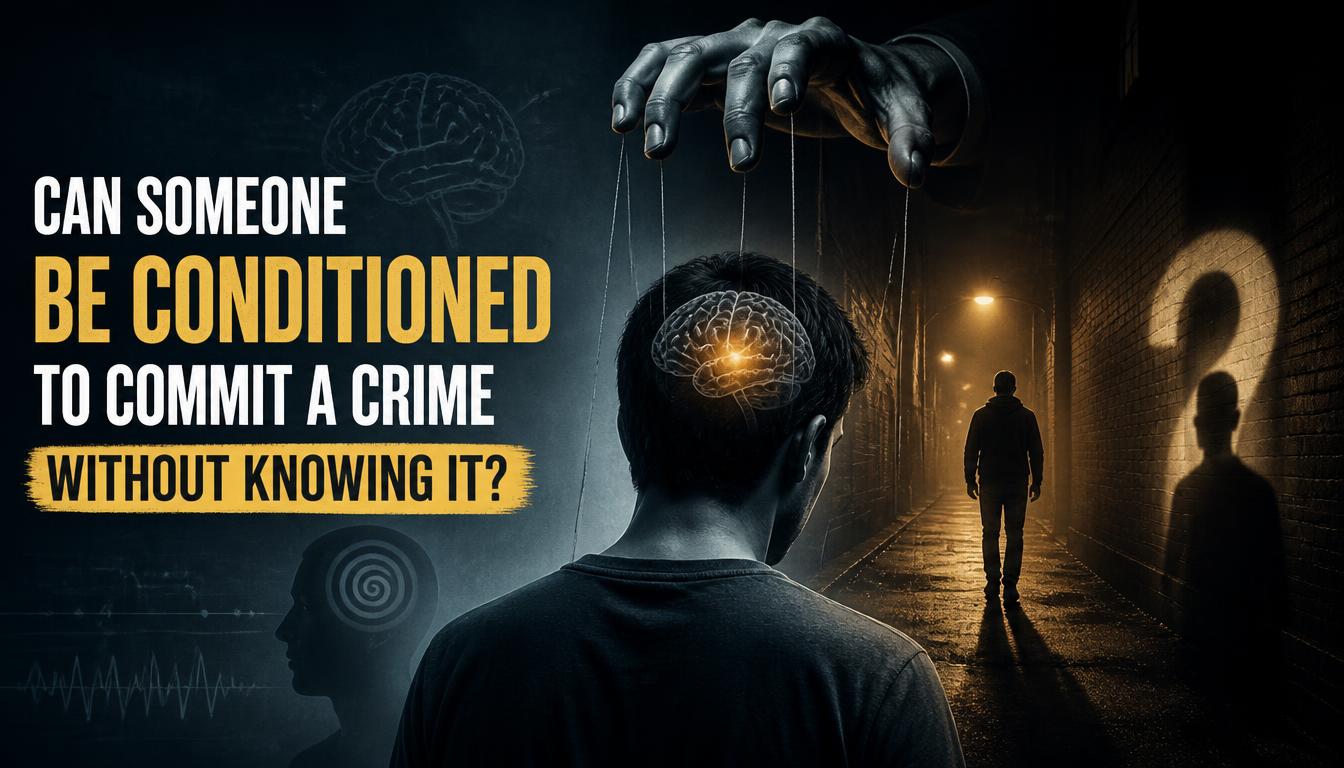
A person commits a crime act and later insists that the behavior felt foreign. They remember fragments, perhaps a place, a voice, or a physical sensation, but cannot explain the decision that put them there.
Crime fiction has explored this idea for decades. What makes it unsettling is the uncertainty about responsibility. If someone’s actions have been shaped by others, how much responsibility do they really have?
This question is central to Expunged by Stephen Pierce.
Conditioning Usually Begins With Ordinary Pressure
People’s behavior can be shaped by repetition, rewards, punishment, fear, isolation, and emotional dependence. None of these methods need advanced technology.
If someone is separated from people they know, they may start depending on those in control of their new surroundings. Repeated instructions can turn into habits. Rewards make people obey, and threats make it risky to resist. Over time, the person may stop thinking about each request as a separate moral decision.
This process works better when the person in control knows what matters to someone. Loyalty, family, guilt, ambition, or wanting to protect others can all be used as pressure points. The person being influenced might think they are doing something good, even if someone else set the goal.
Can Someone Act Without Recognizing the Choice?
The scientific answer requires some caution. Researchers have shown that suggestion can affect memory and a person’s sense of control over an action. A review of hypnosis and agency describes how a person may experience an intentional movement as though it happened involuntarily.
These findings show that memory and the feeling of control are less dependable than most people assume. They do not prove that someone can be programmed like a machine and sent to carry out a complex crime on command.
A real person brings personal beliefs, habits, fears, and limits into every situation. Manipulation works through those existing qualities. It cannot simply replace an entire personality with a new one.
How Expunged Develops the Question
In Expunged, Joey Maldoon comes back after being gone for months. His family hopes for relief, answers, and proof that he is really himself again. Instead, his return only brings more questions.
Joey remembers some of what happened, but he no longer acts the way people expect. He has secrets he cannot easily explain. Sometimes, it seems like he is following instructions that are stronger than his own judgment.
Clark Solo faces the same uncertainty as he investigates a series of murders. Several suspects give odd reasons for what they did. On their own, these stories seem desperate or unbelievable. But when Clark looks at them together, he starts to see a troubling pattern.
The mystery becomes more than just figuring out who did what. Clark has to ask if someone set up the situation, planted the motive, or shaped people’s responses long before the crime happened.
– Some Mysteries Don’t End When the Case Is Closed –
Who Is Responsible for a Conditioned Crime?
Criminal responsibility usually depends partly on intent. Courts ask whether a person understood the act and chose to carry it out. Conditioning complicates both questions.
A manipulated person may still perform each physical step. They may travel to a location, carry an object, and follow a plan. The harder question concerns how that plan entered their mind and why resisting it felt impossible.
Responsibility may extend beyond the person at the crime scene. It may include the individual who selected the target, created the pressure, controlled the information, and turned another person’s fears into instructions.
For the people who love the accused, legal definitions offer limited comfort. Gloria must decide how to trust Joey when neither of them fully understands what has happened to him. Trust becomes especially difficult when a person cannot promise that every thought or impulse is entirely their own.
Why the Idea Feels Uncomfortably Possible
The conditioning in Expunged turns the idea into a thriller, but the emotions behind it are still very human. People influence each other all the time. Authority shapes judgment. Fear limits choices. Repetition changes habits. Secrets make it easier to manipulate others. The novel takes these common pressures much further and asks where influence stops and control starts. One person might commit the crime, while someone else quietly creates the motive.